109) The World of Jennie G. by Elisabeth Ogilvie
A re-read of a childhood favorite that holds up quite well, all things considered. It's the middle book of a trilogy, but it's always been my favorite because it's the one where the protagonists fall in love.
110) Organizing from the Inside Out by Julie Morgenstern
Another re-read, this time of a book I first read in 2010 when we were in the process of buying and moving into our current home. I could tell it had great principles, but Morgenstern advised NOT applying them in the midst of a move, because you need to settle in to your new space a bit to get a feel for how best to organize it. Mind you, I don't think she would've advocated waiting 4+ years, but here we are. I'm thinking of making 2015 the Year of Getting Organized, and maybe even beginning with my office or a closet or two this year. OTOH, next month is NaNoWriMo, then there's Christmas, AND I have books releasing 11/24/14 and 1/5/15...so maybe January is soon enough to start.
111) A.D.: New Orleans After the Deluge by Josh Neufeld
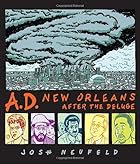
A nonfiction graphic novel (which sounds like nonsense, but calling it a "graphic history" makes it sound like it's a particularly gory history instead of one told largely through illustrations, you know?) following the experiences of several survivors of Hurricane Katrina--both those who evacuated and those who stayed and rode out the storm. A short but intense read, and one that brought the nine-year-old memories of watching the storm from afar vividly back to life.
Showing posts with label New Orleans. Show all posts
Wednesday, October 29, 2014
Wednesday, July 16, 2014
2014 Reading, Books 70-72
Life is starting to calm down a little, so hopefully I'll be returning to a regular blogging schedule soon. In the meantime, here's what I've been reading.
70) Banana: The Fate of the Fruit that Changed the World by Dan Koeppel
A worthwhile read on the history of the banana, especially over the last century as it became the world's most popular fruit, focusing on the political havoc wreaked by the big banana companies in the 20th century and the disease threats imperiling today's banana crops--both the monoculture Cavendish variety (i.e. what an American or European thinks of as "a banana") and the handful of varieties that are major food staples in parts of Africa. A bit dry and meandering compared to some food history books, but I'm glad I read it.
71) Island Beneath the Sea by Isabel Allende
While I tend to agree with the readers who say this isn't Allende's best work, it's still a gorgeously lyrical story of the Haitian Revolution and of New Orleans at the turn of the 19th century.
72) Codex Born by Jim Hines
While not quite as exuberantly fun as Libriomancer, the first book in the series, this is an enjoyable and fast-paced adventure set in a world where libriomancers have the power to pull objects into the world from books.
70) Banana: The Fate of the Fruit that Changed the World by Dan Koeppel
A worthwhile read on the history of the banana, especially over the last century as it became the world's most popular fruit, focusing on the political havoc wreaked by the big banana companies in the 20th century and the disease threats imperiling today's banana crops--both the monoculture Cavendish variety (i.e. what an American or European thinks of as "a banana") and the handful of varieties that are major food staples in parts of Africa. A bit dry and meandering compared to some food history books, but I'm glad I read it.
71) Island Beneath the Sea by Isabel Allende
While I tend to agree with the readers who say this isn't Allende's best work, it's still a gorgeously lyrical story of the Haitian Revolution and of New Orleans at the turn of the 19th century.
72) Codex Born by Jim Hines
While not quite as exuberantly fun as Libriomancer, the first book in the series, this is an enjoyable and fast-paced adventure set in a world where libriomancers have the power to pull objects into the world from books.
Labels:
ecology,
fantasy,
food,
Haitian Revolution,
literary fiction,
New Orleans,
reading,
sustainability
Sunday, June 30, 2013
2013 Reading, Books 61-63
First of all, my apologies for the light posting of late. I'm ultra-busy between now and RWA, really between now and A Dream Defiant's release date on 7/29. Starting in August, I plan to resume my regular posting schedule, including re-starting my Random Cookbook of the Week project.
Anyway, I've managed to squeeze in some reading time, albeit not as much as usual.
61) The New Mind of the South, by Tracy Thompson.
Thompson, like me, has deep roots in the Deep South--her family has been in Georgia for many generations while mine has been in Alabama since there was an Alabama, longer if the tradition that we have Creek blood is true. (Though this book brings up something I've long suspected--that a lot of white Southerners who believe they're part Cherokee or Creek are actually part black. One of these days I'd like to go through 23 and Me to get my ancestry composition just to see how true my family tree and family legends actually are. I'm less curious about the health risk genetic testing, because I don't need to see my DNA to know I'm at high cardiac risk. Simple family history and the fact my blood pressure already runs borderline high tell me that for free.)
Anyway, Thompson and I are also alike in that we've chosen to live our adult lives away from our native soil--she's a reporter living near Washington DC, while in Seattle I'm as far from the Deep South as you can be in the Lower 48. She's a bit older, so her youthful memories are of the 60's, while mine are of the 70's and 80's, but the South is no longer the place we grew up in, for better and for worse. I'm not sure how interesting this book would be for someone without Southern roots, but I found it a fascinating exploration of the less racist but more conservative, more diverse but less rural and sadly sprawl-plagued South of today.
62) A Natural History of Dragons, by Marie Brennan.
A charming fantasy novel--I especially loved the narrative voice--set in a world resembling and obviously based on the Victorian era--the technology is at the steamship level--but with dragons. The heroine and narrator is an aristocratic woman willing to defy society's strictures on women to study dragons, and in this volume (I expect there will be more) we see her childhood, youth, and first expedition.
63) Bounded Lives, Bounded Places: Free Black Society in Colonial New Orleans, 1769-1803, by Kimberly S. Hanger.
More research for the New Orleans WIP, mostly confirming and adding detail to my previous reading on the subject. Surprisingly, the decades of Spanish colonial rule were the best time for the free black community in a lot of ways, compared to earlier French and especially later American rule--their numbers grew through liberal manumission laws, and they were treated with a fair amount of respect, if never quite equality, within the community.
Anyway, I've managed to squeeze in some reading time, albeit not as much as usual.
61) The New Mind of the South, by Tracy Thompson.
Thompson, like me, has deep roots in the Deep South--her family has been in Georgia for many generations while mine has been in Alabama since there was an Alabama, longer if the tradition that we have Creek blood is true. (Though this book brings up something I've long suspected--that a lot of white Southerners who believe they're part Cherokee or Creek are actually part black. One of these days I'd like to go through 23 and Me to get my ancestry composition just to see how true my family tree and family legends actually are. I'm less curious about the health risk genetic testing, because I don't need to see my DNA to know I'm at high cardiac risk. Simple family history and the fact my blood pressure already runs borderline high tell me that for free.)
Anyway, Thompson and I are also alike in that we've chosen to live our adult lives away from our native soil--she's a reporter living near Washington DC, while in Seattle I'm as far from the Deep South as you can be in the Lower 48. She's a bit older, so her youthful memories are of the 60's, while mine are of the 70's and 80's, but the South is no longer the place we grew up in, for better and for worse. I'm not sure how interesting this book would be for someone without Southern roots, but I found it a fascinating exploration of the less racist but more conservative, more diverse but less rural and sadly sprawl-plagued South of today.
62) A Natural History of Dragons, by Marie Brennan.
A charming fantasy novel--I especially loved the narrative voice--set in a world resembling and obviously based on the Victorian era--the technology is at the steamship level--but with dragons. The heroine and narrator is an aristocratic woman willing to defy society's strictures on women to study dragons, and in this volume (I expect there will be more) we see her childhood, youth, and first expedition.
63) Bounded Lives, Bounded Places: Free Black Society in Colonial New Orleans, 1769-1803, by Kimberly S. Hanger.
More research for the New Orleans WIP, mostly confirming and adding detail to my previous reading on the subject. Surprisingly, the decades of Spanish colonial rule were the best time for the free black community in a lot of ways, compared to earlier French and especially later American rule--their numbers grew through liberal manumission laws, and they were treated with a fair amount of respect, if never quite equality, within the community.
Labels:
American history,
current issues,
fantasy,
history,
New Orleans,
reading
Sunday, May 5, 2013
2013 reading, books 43-45
43) Masterless Mistresses, by Emily Clark.
A history of the Ursuline convent established in New Orleans in the early 18th century from its founding through the early 19th century. An academic work, though not as dry as many of its ilk--if you're interested in early New Orleans or women religious, you'll probably enjoy it. Clark focuses on how the Ursulines as women operating autonomously, without a father or a husband as their patriarchal head, challenged the social order of the time.
44) Sweet Awakening, by Marjorie Farrell.
For the 2013 TBR Challenge. Detailed post to come on May 15.
45) River of Stars, by Guy Gavriel Kay.
A sweeping, epic historical fantasy (light on the fantastical elements--there's really only one sequence that's undeniably otherworldly) set in what is obviously an alternate-world version of China. I was caught up in it, staying up till almost 1 AM last night to finish it even though I usually prefer even my doorstopper fantasy sagas to concentrate more intently on one or two characters. (E.g. I love Jacqueline Carey's first-person Kushiel epics.)
That said, I hated the ending. HATED it. I raced through the last 100 pages waiting for the moment everything turned around--and it never did. It's not a wholly depressing ending by any means, and Kay doesn't kill off characters with the abandon of a George RR Martin or even a Joss Whedon. But I was still hoping for something, shall we say, more traditionally satisfying and cathartic. I can be old-school like that. But this morning I looked up the historical events Kay based the story on, and now his choices make a lot more sense. So if you're like me in that you A) are fond of traditionally happy endings and B) know very little about Chinese history, I recommend giving the "History" section of the Wikipedia article on the Song Dynasty a quick read.
Labels:
American history,
fantasy,
historical romance,
New Orleans,
reading
Sunday, April 14, 2013
2013 Reading, Books 34-36
34) Ghost Planet, by Sharon Lynn Fisher. Part of my Rita-finalist reading project, and already blogged about here.
35) Race, Sex, and Social Order in Early New Orleans, by Jennifer Spear.
Friday night I left this book on the dining room table while I was getting dinner ready, and as I brought my 9-year-old daughter's plate to the table, she looked at me in some indignation and pointed to the book. I got it from the University of Washington library, and it's in the dullest academic binding imaginable, with no cover image at all. So I asked her what was wrong, and she pointed more specifically to the word "Sex" printed on the spine. I informed her that in this case "sex" just meant gender, whether you're a man or a woman, and that the book was about how being male or female and the color of your skin impacted your life in 18th century New Orleans. At that point she looked suitably bored.
That said, the book didn't bore me. It covers how interracial relationships evolved and how they were conceptualized from New Orleans' earliest years on into the mid-19th century, an extremely relevant topic for my current work-in-progress set in 1815, whose heroine is a mixed-race fourth generation native of the city. However, it is a dryly academic work that assumes its reader has a decent grounding in the city's colonial history, so it's hardly a general-interest book.
36) Hominids, by Robert J. Sawyer.
A fascinating science fiction novel wherein, in a parallel world, Neanderthals rather than Homo sapiens are the sole surviving hominids. Neanderthal physicist Ponter Boddit accidentally passes through a portal to our Earth, leading to parallel plots as our world tries to figure out what to make of him (and he, of us) and his family and friends try to figure out what happened to him--his partner is accused of murder. I read the book in one sitting this morning, and I'll definitely get the sequel. That said, I thought the Neanderthal society was almost too ideal to be believed, in contrast to our species' warring, overpopulating, and environment-degrading ways, and I thought the use of rape as a plot device was much too heavy-handed. (One of the major Homo sapiens characters is raped by a stranger early in the book, in a scene graphic enough that I expect it would be triggering for quite a few readers.)
35) Race, Sex, and Social Order in Early New Orleans, by Jennifer Spear.
Friday night I left this book on the dining room table while I was getting dinner ready, and as I brought my 9-year-old daughter's plate to the table, she looked at me in some indignation and pointed to the book. I got it from the University of Washington library, and it's in the dullest academic binding imaginable, with no cover image at all. So I asked her what was wrong, and she pointed more specifically to the word "Sex" printed on the spine. I informed her that in this case "sex" just meant gender, whether you're a man or a woman, and that the book was about how being male or female and the color of your skin impacted your life in 18th century New Orleans. At that point she looked suitably bored.
That said, the book didn't bore me. It covers how interracial relationships evolved and how they were conceptualized from New Orleans' earliest years on into the mid-19th century, an extremely relevant topic for my current work-in-progress set in 1815, whose heroine is a mixed-race fourth generation native of the city. However, it is a dryly academic work that assumes its reader has a decent grounding in the city's colonial history, so it's hardly a general-interest book.
36) Hominids, by Robert J. Sawyer.
A fascinating science fiction novel wherein, in a parallel world, Neanderthals rather than Homo sapiens are the sole surviving hominids. Neanderthal physicist Ponter Boddit accidentally passes through a portal to our Earth, leading to parallel plots as our world tries to figure out what to make of him (and he, of us) and his family and friends try to figure out what happened to him--his partner is accused of murder. I read the book in one sitting this morning, and I'll definitely get the sequel. That said, I thought the Neanderthal society was almost too ideal to be believed, in contrast to our species' warring, overpopulating, and environment-degrading ways, and I thought the use of rape as a plot device was much too heavy-handed. (One of the major Homo sapiens characters is raped by a stranger early in the book, in a scene graphic enough that I expect it would be triggering for quite a few readers.)
Subscribe to:
Posts (Atom)
