As often happens when I go to RWA, I've been making midsummer resolutions. One of them is to get back on a regular blogging schedule. I figure I've got two main topics:
1) Books, and the reading and writing thereof
2) Food, and the cooking and eating thereof (with occasional side discussions on health and fitness)
So my new goal is four posts per week, two on each topic. For books, that's one post on what I'm reading and one on something to do with writing--what I'm working on, or aspects of craft, time management, or the business of writing.
On the food side, I'm reluctantly abandoning my 52 Cookbooks series. I'd fallen too far behind on posting, and the blogging was becoming a chore, though the cooking wasn't. So I'm starting fresh. I'm going to keep doing one new-to-me recipe per week from a random cookbook, though I'm going to cull the ones I know aren't very good and add those I've gotten since starting the project.
But I also want to blog a bit about day-to-day cooking. Because my husband has a long commute while mine is quite short, I do most of the weeknight cooking. It's a constant challenge to come up with a variety of interesting and nutritious meals that are FAST, and therefore don't eat up my precious writing time. And as groceries get more and more expensive, I'm looking for ways to eat more frugally. So...fast, frugal, tasty, and nutritious. All at once. Methinks that won't be easy...and therefore that anything I discover might be worth sharing.
Showing posts with label 52 Cookbooks. Show all posts
Showing posts with label 52 Cookbooks. Show all posts
Tuesday, July 31, 2012

Wednesday, July 4, 2012
52 Cookbooks - #30, Best of Home Economics Teachers Bicentennial Cookbook
Even before I learned to cook, I enjoyed paging through cookbooks, and the one in my mother's collection that fascinated me most was The Best of Home Economics Teachers Bicentennial Cookbook. The bicentennial bit was the draw. I was a patriotic wee lass, and already fascinated by history, which this book had bits of in its introduction on regional American cuisines.

At 6 or 7 I took the regional and seasonal/holiday recipes to be prescriptive rather than descriptive, and on some level thought we must be Bad Southerners because we never ate grits and cheese or sausage and hominy scramble, and that if we really wanted to do Halloween right, we needed to start making flying witch cake and molasses-popcorn balls.
Such was the cookbook's fascination for me that it's one of a handful of cookbooks I claimed after both my parents passed away, along with my daddy and grandaddy's Bibles and a circa-1900 speller that belonged to my great-uncle, or maybe my great-great-uncle.
But when I actually sat down to choose a recipe to cook from it, whatever my childhood self found so fascinating wasn't there. It's just a very 70's cookbook, bland and heavy compared to how we cook now. In the end, I settled on the Vanilla Flag Cake.

Vanilla Flag Cake
2 1/2 c all-purpose flour
2 t baking powder
1/4 t salt
1 1/2 c butter, softened
2 c sugar
6 eggs, separated
2 T vanilla extract
2 T lemon juice
Vanilla Cream Cheese Frosting
Fresh blueberries
Fresh strawberries, sliced
Combine flour, baking powder, and salt; set aside. Cream butter and 1 c. sugar in the large bowl of an electric mixer until light and fluffy. Beat in egg yolks, 2 at a time, until mixture is well blended. Blend in flour mixture gradually with electric mixer at low speed until just blended. Blend in vanilla extract and lemon juice.
Beat egg whites until soft peaks form; add remaining 1 c. sugar gradually. Beat until egg whites are stiff but not dry. Fold egg white mixture into cake batter until just blended.
Pour into greased and lined 13 x 9 x 2 inch baking pan. Bake in preheated 325-degree oven until cake tester comes out clean. Frost with Vanilla Cream Cheese Frosting and decorate top of cake with blueberries and strawberries to resemble the American flag.
Vanilla Cream Cheese Frosting
1 8-oz package cream cheese, softened
1 T vanilla extract
1 T milk
1 1-lb package confectioners' sugar
Combine cream cheese, vanilla, and milk; beat until blended. Add confectioners' sugar gradually; beat until creamy.
As I suppose isn't surprising given the amount of butter and eggs, this is one dense, buttery cake, and at least for me it came out a bit on the dry side. Mr Fraser commented that it tasted like a 70's recipe, and I knew what he meant. Eating it brought back the after-church potluck fellowship suppers and baby and bridal showers of my childhood. Miss Fraser thought it was the best thing EVER, and keeps asking when I'm going to make it again. Since I think her real love was the frosting, I might make a nice, moist chocolate cake with the same frosting. If I'm really ambitious and the local berry crop is good in a few weeks, maybe I'll make a British flag cake in honor of the Olympics. Or an Olympic flag cake with blueberries, blackberries, red raspberries, yellow raspberries, and...not sure what to do for the green ring. Mint leaves?
Thursday, June 14, 2012
Catching up on 52 Cookbooks - #29, Food Matters
I admire the philosophy behind Mark Bittman's Food Matters, though what with the day job and my writing career, I just don't have the time to embrace it wholly. Some nights are just going to be pasta served with frozen meatballs mixed with jarred tomato sauce.
Basically, he advocates going back to a more traditional diet with far fewer animal products and refined carbs than the modern American diet. I think he's right; it's just a challenge to balance his recommendation with a hectic lifestyle. I'm working on it, and a few of the recipes in this book are on my go-to list. E.g. for my work breakfast I make a batch of whole-wheat couscous at the beginning of the week flavored with nuts (pecans are tastiest IMHO), maple syrup, and dried fruit, and the Thai beef salad makes an excellent light dinner on a warm evening.
When Food Matters came up in my cookbook rotation, I decided to try one of his dessert options, No-Bake Fruit Tarts:

No-Bake Fruit Tarts
- About four c. fresh fruit, trimmed, cored, peeled, and sliced as needed (I used a mix of fresh berries)
- 1 T sugar
- 1/2 c. brandy, dessert wine, or champagne, optional (I used ice wine, though I made a tart for Miss Fraser sans alcohol)
- 1 c. almonds; or use pecans, walnuts, hazelnuts, or macadamia nuts (despite my passion for pecans, I used almonds)
- 3/4 c. pitted and packed dried fruit (I used apricots)
- 4 oz. good-quality bittersweet chocolate, melted
1. Put the fruit in a bowl. Sprinkle with the sugar, and the liquor if you're using it. Toss gently to coat, and refrigerate while you prepare the crust.
2. Put the nuts in the food processor and pulse until ground, being careful not to overprocess. Transfer to a bowl, then put the dried fruit in the processor along with a tsp or so of water. Pulse until finely chopped and sticky enough to adhere to the nuts (some fruit will require more water than others). Use your hands or a rubber spatula to combine the nuts and fruit until they become a "dough."
3. Divide the dough into 8 pieces and press into 3-inch round disks on a piece of wax paper or parchment; they should be about 1/4-inch thick. Brush each disk with the melted chocolate in a thin, even layer, and top with the fresh fruit and any accumulated juices. Serve immediately.
As you can probably tell from the image above, my tart bases were too wide and thick, and the fruit just sort of slopped over it without sticking. I ended up with three, one for each of us in Casa Fraser, not eight. I think I should've pulsed the nuts into something closer to almond meal. In my zeal to avoid over-processing, I went too far the other way. Also, it might've helped to add a smidge more water to the apricots.
The result as made was edible, but out of balance--too much dried fruit and nut, not enough chocolate and fresh fruit. I ended up with half a bowl of fresh berries left soaking in ice wine, though Mr. Fraser and I did eat them, and I slurped up most of the berry juice and ice wine syrup they left behind. That was pure deliciousness.
Monday, June 4, 2012
Catching up on 52 Cookbooks - #28, Express Lane Meals
When it comes to books, movies, and TV, I don't have guilty pleasures because I don't see why I should feel guilty about reading or watching anything purely for enjoyment or relaxation. In fact, I'm outspoken about the whole range of what I read and watch in part because it's so fun to confound people's expectations of what a woman, or a romance author, or a Penn alum, or an adult, or any other group I'm a part of, is "supposed" to enjoy.
That said, I feel some of that guilty pleasure bashfulness about admitting I own two of Rachael Ray's cookbooks. I can be a bit of a food snob sometimes. While Mr. Fraser and I are hardly rich, eating out a couple times a year at places like Tilth and Boat Street is one of our main indulgences. I don't ask for jewelry and such for birthdays and anniversaries--I'd rather have a really nice, really unique dinner. We celebrated my first sale with a dinner at Canlis, and I've promised Mr. Fraser dinner at The French Laundry should I ever make a major best-seller list. (Though they haven't cropped up yet in the rotation, we have two Keller cookbooks--Ad Hoc at Home and The French Laundry Cookbook.)
The thing is, as much as I'd love to devote long hours to working my way through those Keller books, cooking is a lower priority than my day job (which supports my food, shelter, and transportation habits) and my passion for writing. In fact, most days I just want to get a reasonably tasty, reasonably healthy dinner on the table with enough time left over to write, work out, and even unwind a little before bedtime. And that's what Rachael Ray's cookbooks, her whole approach, is for.
So, you know what? I'm not going to feel guilty about that, either. I'm not a chef, and I am busy. Why shouldn't I work from cookbooks that are designed for people in my circumstances, especially when, as Ray's generally do, they're based around actual fresh ingredients that cook quickly rather than processed shortcuts? I do think Ray's earlier cookbooks are better than her later ones, and her pasta recipes are better than the rest of her repertoire. And the EVOO thing drives me crazy. It doesn't take that much longer to say extra-virgin olive oil.
All that said, Cookbook #28 was Express Lane Meals, and my chosen recipe was...
Drunken Tuscan Pasta
1 bottle Tuscan red table wine such as Rosso di Montalcino or Chianti (I just used a bottle of Oregon pinot noir we happened to have in the house)
Coarse salt
1 lb. spaghetti or other long-cut pasta
3 T. extra-virgin olive oil
1/4 lb. sliced pancetta or bacon
3 portobello mushroom caps, thinly sliced
2-3 sprigs fresh rosemary, leaves finely chopped
4 garlic cloves, chopped
A couple pinches red pepper flakes
4-5 cups chopped dark greens, your choice of chard, escarole, spinach, or kale (I used chard)
Black pepper, to taste
1/4 t. freshly grated nutmeg
Grated Parmigiano-Reggiano cheese, a handful plus more to pass at the table
Pour the entire bottle of wine into a large pot. Add water and salt to fill the pot up as you would to cook pasta. Bring the wine and water to a boil over high heat, add pasta, and cook to al dente, ladling out some cooking liquid for the sauce before draining the pasta.
Heat a large skillet over medium heat. Add 2 T oil, then chop and add the pancetta. Brown the pieces until golden at the edges and transfer them to a paper-towel-lined plate. Add the mushrooms to the same skillet, season with the rosemary, and cook until they are deeply golden, 6-8 min. Push the mushrooms to the sides of the pan, add the remaining oil, and add garlic and red pepper flakes. Cook them for a minute or so, then blend in the mushrooms. Add the greens and season with salt, pepper, and nutmeg. When the greens have wilted, add a couple of ladles of the pasta cooking liquid and cook for a minute to reduce it a little.
Drain the pasta well and add to the skillet. Add the pancetta and a handful of cheese to the pan. Toss the pasta for a minute or so to absorb the remaining liquid. Adjust seasonings and serve.
It looked like this. The pasta isn't whole wheat--cooking in red wine darkens it:

And it tasted delicious. Nothing to feel guilty about at all.
That said, I feel some of that guilty pleasure bashfulness about admitting I own two of Rachael Ray's cookbooks. I can be a bit of a food snob sometimes. While Mr. Fraser and I are hardly rich, eating out a couple times a year at places like Tilth and Boat Street is one of our main indulgences. I don't ask for jewelry and such for birthdays and anniversaries--I'd rather have a really nice, really unique dinner. We celebrated my first sale with a dinner at Canlis, and I've promised Mr. Fraser dinner at The French Laundry should I ever make a major best-seller list. (Though they haven't cropped up yet in the rotation, we have two Keller cookbooks--Ad Hoc at Home and The French Laundry Cookbook.)
The thing is, as much as I'd love to devote long hours to working my way through those Keller books, cooking is a lower priority than my day job (which supports my food, shelter, and transportation habits) and my passion for writing. In fact, most days I just want to get a reasonably tasty, reasonably healthy dinner on the table with enough time left over to write, work out, and even unwind a little before bedtime. And that's what Rachael Ray's cookbooks, her whole approach, is for.
So, you know what? I'm not going to feel guilty about that, either. I'm not a chef, and I am busy. Why shouldn't I work from cookbooks that are designed for people in my circumstances, especially when, as Ray's generally do, they're based around actual fresh ingredients that cook quickly rather than processed shortcuts? I do think Ray's earlier cookbooks are better than her later ones, and her pasta recipes are better than the rest of her repertoire. And the EVOO thing drives me crazy. It doesn't take that much longer to say extra-virgin olive oil.
All that said, Cookbook #28 was Express Lane Meals, and my chosen recipe was...
Drunken Tuscan Pasta
1 bottle Tuscan red table wine such as Rosso di Montalcino or Chianti (I just used a bottle of Oregon pinot noir we happened to have in the house)
Coarse salt
1 lb. spaghetti or other long-cut pasta
3 T. extra-virgin olive oil
1/4 lb. sliced pancetta or bacon
3 portobello mushroom caps, thinly sliced
2-3 sprigs fresh rosemary, leaves finely chopped
4 garlic cloves, chopped
A couple pinches red pepper flakes
4-5 cups chopped dark greens, your choice of chard, escarole, spinach, or kale (I used chard)
Black pepper, to taste
1/4 t. freshly grated nutmeg
Grated Parmigiano-Reggiano cheese, a handful plus more to pass at the table
Pour the entire bottle of wine into a large pot. Add water and salt to fill the pot up as you would to cook pasta. Bring the wine and water to a boil over high heat, add pasta, and cook to al dente, ladling out some cooking liquid for the sauce before draining the pasta.
Heat a large skillet over medium heat. Add 2 T oil, then chop and add the pancetta. Brown the pieces until golden at the edges and transfer them to a paper-towel-lined plate. Add the mushrooms to the same skillet, season with the rosemary, and cook until they are deeply golden, 6-8 min. Push the mushrooms to the sides of the pan, add the remaining oil, and add garlic and red pepper flakes. Cook them for a minute or so, then blend in the mushrooms. Add the greens and season with salt, pepper, and nutmeg. When the greens have wilted, add a couple of ladles of the pasta cooking liquid and cook for a minute to reduce it a little.
Drain the pasta well and add to the skillet. Add the pancetta and a handful of cheese to the pan. Toss the pasta for a minute or so to absorb the remaining liquid. Adjust seasonings and serve.
It looked like this. The pasta isn't whole wheat--cooking in red wine darkens it:
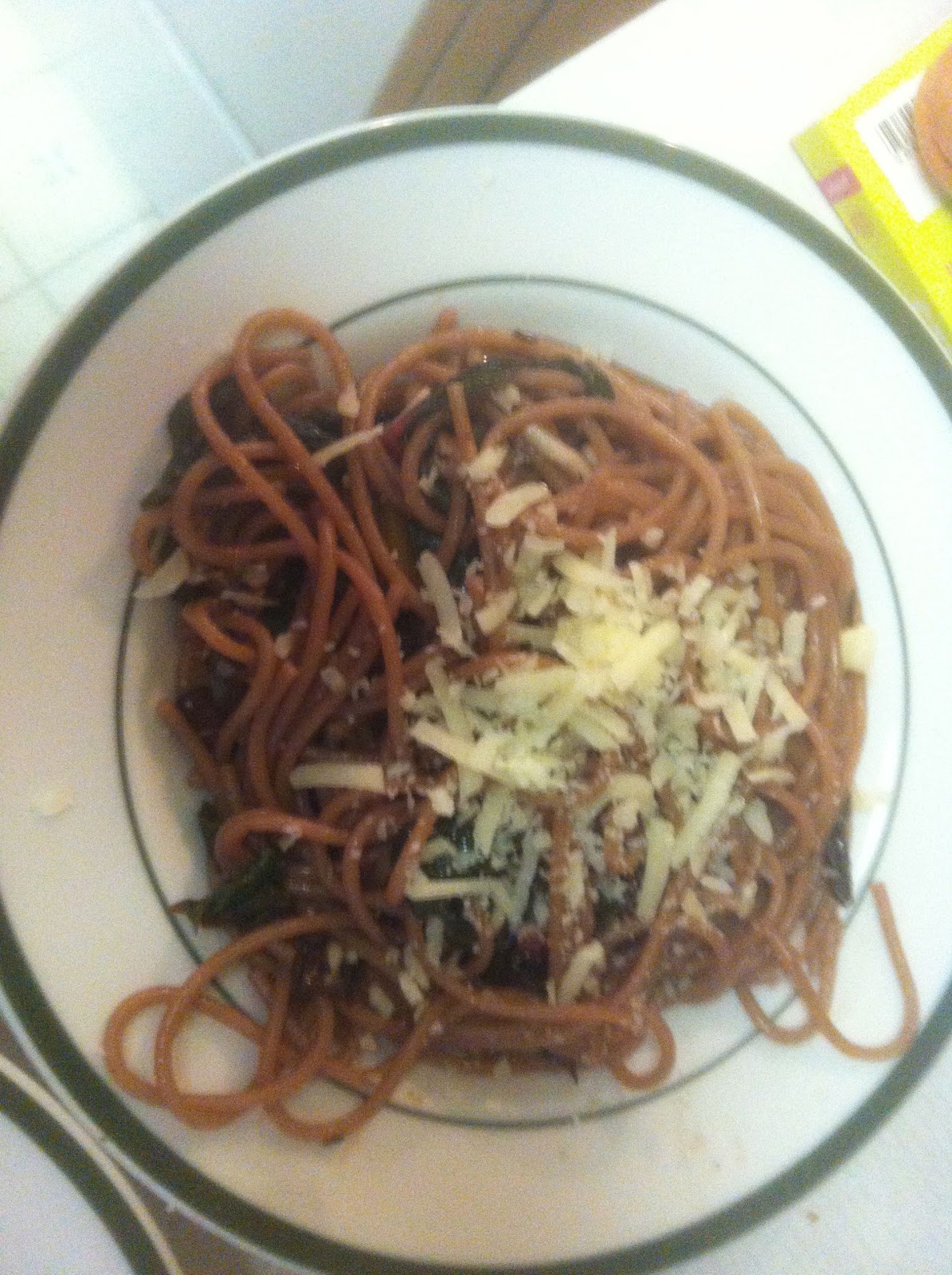
And it tasted delicious. Nothing to feel guilty about at all.
Monday, May 28, 2012
Catching up on 52 Cookbooks: #27, Lobscouse and Spotted Dog
If I ever have time (i.e. if I'm fortunate enough to reach a point where I don't need a full-time day job on top of my writing career), I mean to take up historical reenacting. I always seek out living history museums, and any chance to experience the food, drink, music, clothing, etc. that people from the past, particularly my own characters, might've enjoyed.
I love the dedicated geekery that leads to blogs like Inn at the Crossroads (medieval and modern recipes based on the cuisine of A Song of Ice and Fire, source material for Game of Thrones), and Outlander Kitchen (same thing for Diana Gabaldon's books).
So naturally I own Lobscouse and Spotted Dog: Which It's a Gastronomic Companion to the Aubrey/Maturin Novels. But until this project I never actually cooked from it, and its home isn't with my cookbooks in the kitchen but on the research bookshelf in my office. I grab it sometimes when I need a suitably historical/British dish for my characters to feast upon. None of my other cookbooks talk about drowned babies or spotted dogs, after all. (They're puddings, the old-fashioned boiled kind with lots of dried fruit. I don't see the appeal, but, then, I'm the type who replaces raisins with chocolate chips whenever I make quickbreads or oatmeal cookies. Doubtless my taste buds would've been different had I been born 200 years earlier.)
I wish I hadn't been neck-deep in edits when this came up in the rotation, because I'd love to try Strasburg Pie (bacon & foie gras baked in puff pastry), Ratafia Biscuits, or a Jam Roly-Poly, just to name a few, but I didn't have the time to source ingredients unavailable from Amazon Fresh or my local grocery or to devote most of a weekend afternoon to cooking. So instead I went simple, but a simple dish Jack and Stephen ate all the time:

Yes, I made toasted cheese. Simple as can be--I've heard it described as a simplified Welsh rabbit, but I thought of it as an open-faced grilled cheese. You take bread, whatever kind is handy, along with cheese, whatever kind is handy. I used Italian bread with a mix of cheddar and parmesan--the good stuff, imported-from-Europe foodie cheddar and parmesan, since I figure that's closer to what Jack and Stephen would've had. You toast the bread a bit, then add the cheese and broil. That's all there is to it.
Simple as can be, and gives you a sense of connection to the past. I might prefer a chocolate cake to a drowned baby and pork tenderloin to soused hog's face, but bread and cheese are timeless.
Saturday, May 19, 2012
Catching up on 52 Cookbooks - #26, Good Eats 3
I've always enjoyed Good Eats, and I even met Alton Brown at a book signing once. We have the entire set of his cookbooks, but I rarely cooked from them before this challenge. So many of the Good Eats recipes just seem so involved for an everyday, very busy cook. Don't get me wrong, I'd love to try something like Brown's coconut cake, but since cooking of necessity comes third behind writing and the day job among my commitments, I rarely have the time or energy for something of that magnitude.
While I doubt I'll be taking on his more complex projects, now that I've sampled a few of his recipes, I plan to try a lot more. These recipes work, and he explains the steps with enough clarity to reassure the cook who's never tried a particular technique before.
For the midpoint of my random cooking year, I drew Good Eats 3: The Later Years. After browsing, I settled on Oven Roasted Broccoli (see link for recipe), because Brown recommended it for people who normally find broccoli too bitter. It's a definite winner. Best-tasting broccoli I've ever had, without any of that icky bitter mushiness broccoli so easily gets, and only slightly more work than steaming or stir-frying.
Halfway through this project, I've already decided to promote some of my little-used cookbooks to the regular rotation--not least Alton Brown's--while others will get even less play. In general, I'm finding my older cookbooks, especially those that are fundraiser collections rather than single-authored, just don't have a lot of appealing recipes. That surprises me a little--I'd expected my taste buds to have more nostalgia for the kind of food I ate growing up. It feels weird to even think of giving away The Moosewood Cookbook or the 1990's Joy of Cooking, but if I want vegetarian recipes or just a comprehensive encyclopedia of anything a home cook might venture on, my Mark Bittman books pretty much have that covered.
After I've finished my 52 cookbooks, I think I'll keep doing a random rotation--it's a fun challenge, and it gives me something to blog about--but I'll stick to those books I actually liked on this go-round.
Saturday, May 12, 2012
Catching up on 52 Cookbooks - #25, Enough to Feed an Army
When I was an undergrad at Penn, not quite when dinosaurs roamed the planet, but I swear there were still woolly mammoths about (OK, OK, it was 20 years ago), my brother was a math instructor at West Point. While they were there, my sister-in-law contributed to Enough to Feed an Army: the West Point Officers Wives' Club Cookbook.

It isn't listed on Amazon, so no link, but it's a typical compilation cookbook, with West Point facts and images interspersed here and there. I got my pumpkin and banana bread recipes from it, though I use chocolate chips instead of the suggested walnuts. This time, I decided I wanted to pick a vegetable recipe, so I settled on:
Warm Green Bean and Pancetta Salad
1 1/2 lbs. green beans, trimmed
5 oz. pancetta, diced
1/3 c. minced shallots
1 T chopped fresh rosemary or 1 1/2 t. dried rosemary (I used fresh, since we have some growing in our front yard)
3 T olive oil
2 T plus 1 t. fresh lemon juice (I interpreted this as "juice of 1 lemon")
Cook beans in large pot of boiling, salted water until crisp-tender; drain. Rinse with cold water and drain well. Pat dry.
(I chose to steam the beans instead, since I prefer my beans very lightly cooked.)
Cook pancetta in heavy large skillet over medium heat until crisp, stirring often. Transfer pancetta to paper towels. Pour off all but 1 1/2 T fat. Add shallots and chopped rosemary to skillet and cook over medium heat 2 min, stirring often. Add beans and stir to coat. Add oil and lemon juice; stir until beans are heated through. Season with salt and pepper. Sprinkle with pancetta.

The beans turned out quite tasty. They're not enough better than my usual preparation, which is just to stir fry till hot in a little olive oil with garlic, salt, and pepper, to replace it for everyday meals. But I can see myself making it as a side dish at a dinner party someday.
Thursday, May 10, 2012
Catching up on 52 Cookbooks - #24, The Pie and Pastry Bible
(I've been cooking from a random cookbook each week even when I've been too busy with edits to blog about it, so now that I'm back in the land of the blogging I'll be posting a month's worth of catch-up entries.)
I don't think of myself as a pie person even though the last few years I've made the pecan and pumpkin pies at our family Christmas celebrations, and depending on the season I often make a pecan or a berry pie when we have dinner guests. You see, a real pie person would make her own crusts, and for some reason homemade pie crusts intimidate me. I feel the same way about yeast breads. I'm game for anything else that's within a normal home cook's repertoire, but those two feel like you need a PhD in advanced cookery to tackle, or something. I don't claim this is rational. Maybe next year my culinary challenge will be "overcome yeast phobia."
My mom could do both, naturally. She rarely baked bread, but she made pies ALL THE TIME, always made her own crusts, and looked with scorn upon ready-made pie shells. I mean, next thing you'd be making your cakes from a MIX.
So now, whenever anyone praises my pecan pie, I'm all self-deprecating and say, "Oh, thanks, but I cheated. I used a store-bought crust. My mom would've made the crust, too." And when The Pie and Pastry Bible came up in the rotation, I felt preemptively guilty, because I knew I'd end up cheating and using a ready-made crust.
But I did not! Instead I chose to make...
CRUSTLESS APPLE CRUMB PIE
5 c. baking apples, peeled & sliced 1/2 inch thick (~3 large)
1 1/2 t. freshly squeezed lemon juice
2 T light brown sugar
2 T granulated sugar
3/4 t. ground cinnamon
1/8 t. nutmeg, pref. freshly grated
1/8 t. salt
1 T unsalted butter
FOR TOPPING:
2 T + 2 t. light brown sugar
1 T. sugar
1/2 c. walnut halves
1/16 t. salt
3/4 t. ground cinnamon
1/2 c. all-purpose flour
1/4 c. unsalted butter, melted
3/4 t. vanilla extract
EQUIPMENT: a 9-inch pie pan
Preheat oven to 400 F. Set oven rack on 2nd level from the bottom.
In a large bowl, combine apples, lemon juice, sugars, cinnamon, nutmeg, and salt and toss to mix. Allow the mixture to sit for 30 minutes to an hour.
MAKE THE TOPPING:
In a food processor, pulse together sugars, nuts, salt, and cinnamon until the nuts are coarsely chopped. Add the flour, butter, and vanilla and pulse until the mixture is coarse and crumbly. Empty into a small bowl and with your fingertips lightly pinch the mixture to form little clumps.
Transfer the apples and their juices to a colander suspended over a bowl to capture the liquid. The mixture will exude about 1/4 c. of liquid.
In a small saucepan, reduce this liquid, over medium-high heat, with the butter, to 2 T. Pour the hot liquid over the apples, tossing them gently.
Transfer the apples to the baking dish. Pour in all the remaining juice. Cover the dish with foil and make a 1-inch slash in the middle. Bake the apples for 30 minutes.
Remove the foil and sprinkle the surface evenly with the topping. Continue baking for 20-25 minutes or until the topping is crisp and golden brown, the fruit juices are bubbling thickly around the edges, and the apples feel tender but not mushy when a cake tester or small sharp knife is inserted.
Cool on a rack and serve warm or at room temperature.
It came out looking like this:

Not the most photogenic dessert ever. It was reasonably tasty, though not enough so to justify the amount of work that went into it. It would've been far better with some vanilla or dulce de leche ice cream, though.
Sunday, April 8, 2012
52 Cookbooks - Week 23, Just Chocolate Cookbook
This week for Easter I drew a Christmas cookbook, the Christmas at Home Just Chocolate Cookbook, which I got as a stocking stuffer a couple years back.
Not being in the mood for Christmassy cookies or cakes, I turned to the breakfast section at the very back. I rejected pumpkin and banana breads with chocolate chips as things I already make all the time and tried my hand at this:
Chocolate Apple Bread
1 c and 2 tsp sugar, divided
3/4 tsp cinnamon, divided
3/4 c walnuts, finely chopped and divided
2 c flour
1/2 tsp salt
1/2 tsp baking powder
1/2 tsp baking soda
1/4 tsp nutmeg
1/2 c butter, softened
2 eggs
1 tsp vanilla
2 T buttermilk
2 c apples, peeled, cored, and coarsely chopped
1 c semisweet chocolate chips
Preheat oven to 350. In a small bowl, combine 2 tsp sugar, 1/4 tsp cinnamon, and 1/4 c walnuts; set aside. In a medium bowl, mix flour, salt, baking powder, baking soda, remaining cinnamon, and nutmeg, set aside. In a large bowl, cream butter and remaining sugar together; add eggs and vanilla. Gradually add the flour mixture and buttermilk. Fold in apples, remaining walnuts, and chocolate chips. Pour mixture into a greased 9x5 inch loaf pan. Sprinkle with the sugar, cinnamon, and walnut mixture. Bake for 55 to 60 minutes. Allow to cool for 20 minutes before removing from the pan.
I cooked it for more like 75 minutes, since when I tested for doneness at 1 hour it was still runny. It came out like this:

Apples and chocolate may sound like a strange combo, but this made for a tasty Easter breakfast and a worthy addition to my cookbook repertoire.
Monday, March 19, 2012
52 Cookbooks - Week 21, Cook it Together
I'm a couple cookbooks behind on blogging this project, but I still remember what I thought of the recipes, so here goes:
Cookbook #21 was Cook It Together, a children's cookbook by Annabel Karmel. I gave Miss Fraser (age 7) free rein to choose a recipe, and she selected the exact one I expected:
Banana Bites
1-2 bananas
4 oz. chocolate (milk or semisweet)
dried coconut and/or sprinkles
1) Peel the bananas and trim off the ends. Chop the flesh into bite-sized pieces.
2) Break the chocolate into a heat-proof bowl. (Or measure out the chocolate chips.) Put the bowl over a pan of hot water to melt the chocolate, stirring occasionally. Leave to cool slightly.
3) Push a straw through each banana piece, then drizzle melted chocolate over it.
4) Roll the chocolate-covered banana in the coconut or sprinkles. Let the chocolate harden, then serve.

Our verdict? Messy yet tasty. To simplify, you could just roll whole bananas in melted chocolate and sprinkles, etc. That's the way they did it at Miss Fraser's after-school club a few weeks later, and she liked that way better.
Thursday, March 1, 2012
52 Cookbooks - Week 20, Best One-Dish Meals
Last week's cookbook drawing gave me McCall's Best One-Dish Meals, a 1994 cookbook ("McCall's reinvents one-dish meals for the '90s!") credited to the editors of that magazine. (Which I just learned through the powers of Google and Wikipedia is now extinct, having been briefly owned by Rosie O'Donnell before ceasing publication 10 years ago.)
Busy author/mom/day-jobbed grant analyst that I am, I'm all about the one-dish meals. Anything quick and convenient that's still reasonably healthy and tasty is a blessing. Despite that, I've rarely turned to this cookbook--I don't even remember how I got it--but I was game to try and chose recipes for two meals.

Pumpkin-Peanut Soup
- 1 sugar pumpkin or butternut squash (3 lbs) or 4 cups canned solid-pack pumpkin puree (NOT pie filling)
- 1 tsp salt
- 1/4 tsp ground black pepper
- 4 T butter
- 1 c. chopped onion
- 1/2 c. finely diced sweet red pepper
- 1 large jalapeno pepper, cored, seeded, and minced
- 4 c. chicken broth
- 1/4 c. creamy peanut butter
- 1/2 c. heavy cream or milk
- 2 T fresh lime juice (which I interpreted as "juice of one lime')
- thinly sliced green onion
1) If using fresh pumpkin or squash, roast at 350F until soft. When cool enough to handle, scoop flesh into a bowl.
2) In a Dutch oven, melt the butter over medium heat. Add the onion, saute for 15 min or until golden brown. Add the pumpkin, red pepper, jalapeno, and chicken broth. Heat to boiling. Cover; reduce the heat to low. Simmer 10 min, stirring occasionally. Remove all but 2 c. of the soup solids to a food processor. Puree in batches. Pour the puree into the reserved soup in the pot. Add the peanut butter and heavy cream. Over low heat, cook, stirring, until the peanut butter melts. Add the lime juice, salt, and pepper. Sprinkle each serving with green onion.
I made this as a weekend dinner, accompanied by warm French bread and andouille sausage, and I thought it was tasty. To me, the hint of peanut butter and the brightness of the lime juice made the flavor pop. Mr. Fraser, however, thought it far too peanutty, and the very finicky Miss Fraser took one bite and turned up her nose. So I probably won't make it again, especially considering that when something is advertised as a one-dish meal, I don't expect the sink and counter to look like this when I'm done:

Granted, the sink wasn't 100% empty when I started--I think there was a frying pan from the previous night that hadn't fit into the dishwasher, plus a coffee cup or two. Still, that's without the actual soup pot, which was still on the stove when I took the picture.
Later in the week I tried chicken hash:
Chicken Hash
- 2 baking potatoes (about 1 1/2 lbs), scrubbed and cut into 3/4-in dice
- 2 t salt
- 2 t chopped fresh rosemary leaves or 1/2 t dried rosemary
- 1 t freshly ground black pepper
- 4 T unsalted butter
- 1 1/2 c. sweet onion, cut into 3/4-in dice
- 1 sweet red pepper, cut into 3/4-in dice
- 3 1/2 c. cooked chicken, cut into bite-sized pieces
- 1 T olive oil
- 1/3 c heavy cream
1) Place potatoes in a medium saucepan with enough water to cover. Add 1 t. salt. Bring to a boil. Reduce heat, cover, and simmer 4-5 min or until the potatoes are cooked through but not mushy. Drain the potatoes and rinse under cold running water until thoroughly cooled. Drain well.
2) In a cup, combine the remaining salt, the rosemary, and the ground pepper. Stir until blended, set aside.
3) In a 12-in cast iron skillet (or just a regular skillet, which I used with good results) over medium-high heat, melt 2 T butter. Add onion and red pepper and saute 5 min or until tender. With a slotted spoon, transfer vegetables to a bowl. Add 1 T butter to skillet. Over med-high heat, when the butter is foaming, add the chicken and half of the herb mixture. Cook about 2 min, turning the chicken only a few times. Transfer chicken to bowl with vegetables. Add remaining butter and olive oil to skillet. When the butter is foaming, add the potatoes and remaining herb mixture to skillet. Cook 6-8 min or until potatoes begin to brown, turning the potatoes twice during the cooking time.
4) Add the chicken-vegetable mixture to the potatoes in the skillet. Toss until well mixed. Lightly pat down the hash. Pour the heavy cream around the edges of the skillet and over the center of the hash. Cook for 5 minutes, turning the hash occasionally, until it is crusty.
Again Mr. Fraser and I had a difference of opinion. I thought it was delicious, in a soothing homy, salty, buttery sort of way, while he gave it a "meh." That said, I'll probably make it again, because it's quick and simple, more so than the recipe makes it sound.
Monday, February 20, 2012
52 Cookbooks - Week 19, The Moosewood Cookbook
The Moosewood Cookbook, by Mollie Katzen, looks interesting, but over the years my attempts to cook from its selection of vegetarian recipes have mostly turned out odd yet bland.
When it came up in last week's random draw, I headed straight to the dessert section, since I had an overabundance of Granny Smith apples I wanted to bake something with before they went bad. I also had an extra pie shell from when I made chocolate-pecan pie back at Christmastime, so my selection was a no-brainer:
Apple Custard Pie
2 c. peeled & thinly sliced tart apples
1 unbaked 9-in pie crust
4 eggs
1/4 to 1/3 c. brown sugar or honey (I used maple syrup, which was listed as an optional variation)
1 c. yogurt
1 t. vanilla extract
1/2 t. cinnamon
1/4 t. salt
1) Preheat oven to 375.
2) Spread the apple slices evenly over the pie crust.
3) Combine all remaining ingredients in a food processor or blender and whip until frothy. Pour this custard over the apples.
4) Bake for 45 min. or until solid in the center. Cool for at least 1 hour before slicing. Best at room temperature or cold.
Here's what it looked like. The picture doesn't quite do justice to how strange the creamy custard filling looked compared to an ordinary apple pie.

How did it taste, you ask? Well, it's a seriously weird pie. (Not to be confused with Serious Pie, which you must try next time you happen to be in Seattle.) Odd, yet bland.
Wednesday, February 15, 2012
52 Cookbooks - Week 18, The Best Recipes in the World
Next up in my random draw of cookbooks was The Best Recipes in the World, by Mark Bittman. It's an ambitious survey of world cuisine for the home cook. Bittman goes relatively light on French and Italian recipes, figuring most skilled American cooks already know those cuisines, in order to focus on everywhere else. I could've gone Caribbean, Greek, or Eastern European, to name only a few, but I chose Asian recipes for my weeknight dinner. (And, as always on weeknights, I forgot to take pictures.)
Two-Way Chicken
(I chose the Thai variation--adding sugar and nam pla would've made it more Vietnamese.)
2 1/2 - 3 lbs chicken parts
3 T soy sauce
1 T minced garlic
1 T peeled and minced fresh ginger
1 t hot pepper flakes
1 T neutral oil
Lime wedges for serving, optional
Chopped fresh cilantro for garnish
1) Place the chicken in a large bowl with the soy sauce, garlic, ginger, and hot pepper flakes. Toss well to coat and proceed or cover and refrigerate for up to a day.
2) Place the oil in a large, deep skillet over med-high heat. After a minute or so, when the oil is hot, remove the chicken from the marinade and add it, skin side down, to the skillet. Brown it well on both sides, rotating and turning the pieces as necessary, about 10 minutes. Lower the heat and continue to cook, turning as necessary, until the chicken is cooked thorugh, about 15 minutes longer, removing the pieces as they finish cooking. (It took them more like 25 min. to finish, and I was only using drumsticks and thighs.)
3) Serve the chicken with lime wedges, hot, warm, or at room temperature, garnished with cilantro.
This was a pretty good recipe, not something grand and fancy I'd want to serve to company while showing off, but a pleasant weeknight dinner for a day I have time to do more than boil spaghetti or scramble eggs. For a vegetable side I chose:
Quick-Braised Root Vegetables with Hoisin
2 T neutral oil
1 T chopped garlic
1 T peeled and minced fresh ginger
4 med carrots, roughly chopped
4 parsnips, peeled and roughly chopped
2 celery stalks, roughly chopped
2 T hoisin sauce
1 T soy sauce
3 scallions, trimmed and cut into 1-inch lengths
1) Heat a wok or large skillet with a lid over med-high heat for about 3 minutes, or until it is quite hot. Add the oil, garlic, and ginger and stir for 10 seconds. Add the vegetables and cook, stirring, until they begin to brown, 2-3 min.
2) Lower the heat to med and add 1/2 c. water or stock (I used chicken stock to add a little more flavor), along with the hoisin sauce and soy sauce; stir. Cover and cook over med-low heat until the vegetables are tender, about 10 min. Uncover, raise the heat to high, and add the scallions. Cook, stirring, until the liquid has all but evaporated, just a couple of minutes. Serve immediately.
Now, this was an excellent recipe, and the quickest, most flavorful preparation of fresh root vegetables I've run across.
Sunday, February 5, 2012
52 Cookbooks - Week 17, 1997 Joy of Cooking
I'm the proud owner of two editions of the Joy of Cooking--a 1997 edition, which my parents gave me for Christmas in 1998, the year before Mr. Fraser and I got married, and the 1951 one, which I inherited from my mom. Last week I drew the 1997 version. I haven't cooked from it much in the last 14 years, partly because it's just so dauntingly encyclopedic.
But at the front of the book are a couple pages of menu suggestions, and I decided to choose one--beef stew, roasted garlic spread on baguette slices, and apple-spice cake.
Beef Stew
- 2 lb. boneless stewing beef, such as chuck, short-rib meat, or bottom round, cut into 2-inch cubes
Season the meat with:
- 1/2 to 1 t. dried herbs (thyme, marjoram, savory, oregano, and/or basil)--I used all but the savory
- 1/2 t. salt
- 1/2 t. black pepper
Dredge the meat with:
- 1/2 c. all-purpose flour
Shake off any excess flour. Heat in a Dutch oven over medium-high heat:
- 2 T olive or vegetable oil, bacon fat, beef drippings, or other fat--I used canola oil
Add the meat in batches and brown on all sides, being careful not to crowd the pan or scorch the meat. Remove with a slotted spoon. Pour off all but 2 T of fat from pan (add more if needed). Add:
- 1/2 c. chopped onions
- 1/4 c. chopped carrots
- 1/4 c. chopped celery
- 1/4 c. chopped leeks (optional)
- 2 T chopped garlic (optional)
(I used the garlic, but not the leeks.)
Cover and cook, stirring often, over medium heat until the onions are softened, about 5 minutes. Add:
- 2 bay leaves
- 1/2 to 1 t. of the same herbs used to season the meat
- 1/2 t. salt
- 1/2 t. ground black pepper
Add enough to cover the meat at least halfway:
- 2 or 3 c. beef or chicken stock, dry red or white wine, or beer--I used 3 c. of red wine
Bring to a boil. Reduce the heat, cover, and simmer over low heat until the meat is fork-tender, 1 1/2 to 2 hours. Add:
- 2 to 3 carrots, peeled and cut into 1-inch chunks
- 3 to 4 boiling potatoes, peeled and cut into 1-inch chunks
- 2 turnips, peeled and cut into 1-inch chunks
- 2 parsnips, peeled and cut into 1-inch chunks.
Cover and cook until the vegetables are tender, 35-40 min. Remove the pan from the heat and skim off any fat from the surface. Taste and adjust the seasonings. If you wish, thicken the sauce by stirring together and whisking into the stew:
- 1 to 1/2 T kneaded butter--I did not add
Simmer, stirring, until thickened. Garnish with:
- Chopped fresh parsley
It looked like this:

As you can see, I forgot the parsley garnish. It was a long Sunday afternoon of cooking, and by then I was pretty tired.
Unfortunately, the turnip completely spoiled it for me. It had a sort of bitter, metallic taste that ruined the dish, at least for my taste buds. Mr. Fraser found it edible, if unexciting. I'd probably like it OK if I substituted extra potatoes and carrots for the turnips, but for that much chopping and cooking I expect more than "like it OK." The roasted garlic smeared on bread was good, though--how could it not be? I'm not including the recipes for those two, because I just roasted the former the way I always do, and bought a baguette from my friendly local grocer.
Dessert was:
Apple Spice Cake
Preheat the oven to 350 F. Grease and flour one 8x8 inch pan or line the bottom with wax or parchment paper.
Whisk together thoroughly in a large bowl, pinching out any lumps in the brown sugar:
- 1 1/2 c. all-purpose flour
- 1 c. packed dark or light brown sugar
- 1 t. baking soda
- 1 t. ground cinnamon
- 1 t. ground cloves
- 1/2 t. freshly grated or ground nutmeg
- 1/2 t. salt
Add and stir together until smooth:
- 1 c. buttermilk
- 1/2 c. vegetable oil
- 2 T. rum or brandy (optional)--I used rum
- 1 t. vanilla
Stir in:
- 1 c. chopped apples
- 1/2 c. chopped walnuts or pecans--I used pecans
Scrape batter into the pan and spread evenly. Bake until a toothpick inserted into the center comes clean, 40-45 min. Let cool in the pan on a rack for 10 min. Slide a thin knife around the cake to detach it from the pan. Invert the cake and peel off the paper liner, if using. Let cool right side up on the rack. Serve warm plain or with vanilla ice cream. Or let cool completely and frost with white, butterscotch, or penuche icing.
I served it with vanilla ice cream, and it was a sophisticated, subtly spicy dessert which also served for breakfast the next two mornings.
Saturday, January 28, 2012
52 Cookbooks - Week 16, Colorado Cache
Though Mr. Fraser grew up in Oklahoma, he has family in Denver (and he's an alum of the University of Colorado). Because of that connection, one of our 52 cookbooks is the Colorado Cache Cookbook, a 1978 production of the Junior League of Denver.
I'm trying to up my vegetable intake and get out of the habit of eating the same round of carrots, bell peppers, green beans, and caesar salad again and again, so I decided to try Honey-Glazed Acorn Squash. It reminded me of a recipe my mother used to make with butternut squash and molasses:

Honey-Glazed Acorn Squash
4-6 servings
2 or 3 acorn squash
salt and pepper to taste
1/4 c. honey
2 T butter, softened
1 T Worcestershire sauce
1/4 c. chopped walnuts
1/4 c. raisins
Cut squash in half, remove seeds. Place cut-side down in shallow pan. Add 1/2 inch hot water to pan. Bake uncovered at 350 degrees for 40-50 minutes or until almost tender. Turn cut-side up, season with salt and pepper. Combine other ingredients and spoon into cavities of squash. Bake uncovered at 350 degrees for 15 minutes or until filling is heated.
The good: It's a simple, straightforward preparation. The hardest part was sawing through the squash.
The bad: It's edible, but I wouldn't go beyond that--on the bland side, and the squash is somehow squishy AND stringy. I think my mom's butternut squash with molasses tasted better, and I didn't even much like squash when I was a kid.
Thursday, January 19, 2012
52 Cookbooks - Catching up
I've still been cooking a new recipe from one of my randomly chosen cookbooks every week except when we were out of town for Christmas, but between one thing and another, I've neglected to blog about it. I intend to go back to proper blogging with recipes and pictures next week, but here's a quick summary of the cooking I've been doing in the meantime:
Mom and Me Cookbook, by Annabel Karmel. I made spaghetti with homemade tomato sauce with Miss Fraser, age 7. She enjoyed it, and I mean to find ways to cook with her more often, at least once or twice a month, so she'll learn.
Calling All Cooks Two, by the Alabama Telephone Pioneers. Lesson learned from this week: if you're making a chocolate-pecan pie, choose one with more pecans than chocolate. Otherwise it's so chocolatey you can't taste the pecans.
How to Cook Everything, by Mark Bittman. I also have the mobile app, so I decided to make the two top-rated recipes. The meatloaf turned out tasty, if a smidge on the bland side, but I'm baffled by the popularity of the "boiled water" soup. It's sort of like French onion soup, but with garlic. To me, it's boring and a waste of good garlic.
Good Eats 2: The Middle Years, by Alton Brown. I think this is my favorite of the cookbooks I've attempted so far. I made broiled steak, German hot slaw, and chipotle-mashed sweet potatoes, all of which I'd gladly make again.
Friday, December 16, 2011
52 Cookbooks - Weeks 10 & 11
Another double post. Also, a friend pointed out to me that these posts would be more interesting if I included the recipes, so from now on I will. My understanding is that there's no copyright issue with quoting a recipe or two from a cookbook, but please do correct me if I'm wrong.
Last week I drew the Weight Watchers New Complete Cookbook (from 1998, so not all that new anymore). It's not a bad cookbook, but it's not particularly exciting, either. I chose Southern Oven "Fried" Chicken because I had the ingredients readily to hand:
1/2 c. fat free buttermilk
2-3 drops hot red pepper sauce
1/2 c. cornflakes, crushed
3 T all-purpose flour
1/4 tsp salt
1/4 tsp freshly ground pepper
2 lbs. chicken parts, skinned
4 tsp canola oil
1) Preheat the oven to 400F. Spray a large baking sheet with nonstick cooking spray.
2) In a large, shallow bowl, combine buttermilk and pepper sauce. On a sheet of waxed paper, combine cornflake crumbs, flour, salt, and pepper. Dip chicken in buttermilk, then dredge in cornflake mixture, coating completely. Place on baking sheet, drizzle with oil. Bake 30 min., turn over, and bake 15-20 min longer until cooked through.
My modifications: I used boneless, skinless chicken breasts because it turned out I didn't have thighs and drumsticks left in the freezer after all. I soaked the chicken for several hours in the buttermilk because I know that works from previous recipes. I used at least a teaspoon of hot sauce and didn't bother measuring salt and pepper. And it took me more like two cups of cornflake crumbs to get the chicken coated. Oh, and I cooked it at 350 instead of 400, because that seemed a little hot for pieces as prone to drying out as boneless breasts.
The results: Meh. Edible, something you could throw together quickly. Nothing exciting or memorable.
This week's cookbook was Life After Pizza, which I used to teach myself to cook in college and the first few years thereafter. It covers everything from basics like how to scramble an egg and soups you can make by mixing various canned condensed soups to yeast breads and souffles (neither of which I've ever mastered). I still consult it now and again for reminders of cooking times and such for basics I haven't made in awhile, and I confess to a fondness for one of those canned soup blends. Finding a recipe in it I'd never made before that sounded appealing was a challenge, but I finally settled on:
Pizza Pasta
1/4 c olive oil
1 large onion, thinly sliced
2 green peppers, sliced
8 oz. thinly sliced pepperoni
2 cloves garlic, minced
1 15 oz. can tomatoes
1 tsp oregano
1/2 tsp salt
cooked pasta
1) Heat oil in skillet over medium heat. Add onion, peppers, pepperoni, and garlic. Cook for 5 min, stirring constantly.
2) Mix in tomatoes, oregano, and salt. Cook, covered for 5 min. Remove cover, cook for 5 min until sauce thickens slightly.
3) Pour over pasta, serve with parmesan cheese.
Modifications: I used 3 oz. of pepperoni, because that's what the package I'd picked up at the store held. It was still too much. I added another half can of tomatoes, because it didn't look saucy enough. I doubled the oregano.
The results: Not inedible, but I'll never make it again. My younger self would've enjoyed the pizza-topping gimmickry, but my older, somewhat skilled cook of a current self can make a better homemade pasta sauce improv. And the pepperoni just doesn't work at all.
Thursday, December 1, 2011
52 Cookbooks - Week 8 & 9
Just a quick post to catch up on the last two weeks of 52 Cookbooks:
The week before last I drew The New Covent Garden Soup Company's Book of Soups, a cookbook Mr. Fraser bought the year we lived in England (we met there, started dating within a month or two, and got married a year after returning to the States and nearly two years to the day after we met). To get into the proper spirit of the thing, I made their vegetable stock despite certain oddities of ingredient. (Lettuce? Cooked? In a stock? Really?) And I'm glad I did. It gave the resulting soups a freshness and lightness you just don't get with canned stock.
I first made Cheese Soup with Crispy Bacon, which was every bit as yummy as it sounds, but nowhere near as heavy:

Since I had plenty of stock left over, I made their herbed cream of chicken soup and served it alongside a pesto bread recipe (bruschetta, basically) from my Week 9 cookbook, Starters and Closers, the Mariners' wives charity fundraiser cookbook from the 2001 season--i.e. back when we had a really good team. (Though that 116-win season is a lot less glorious in retrospect, since we weren't able to follow it up with a championship and have been wallowing in futility since 2004. But I digress.) Anyway, I decided to make one "starter"--the appetizer pesto bread--and one "closer"--Mike Cameron's contribution to the dessert section, cinnamon-dipped marshmallows baked inside crescent rolls. I thought they were kinda gross, but my husband and daughter ate them all.

Thursday, November 17, 2011
52 Cookbooks - Week 7, Everyday Food
This week for the first time I drew a cookbook I already use fairly frequently, Everyday Food: Great Food Fast. It's a 2007 collection by the editors of Everyday Food magazine, so it's full of recipes suited to current tastes and food trends, without being too labor-intensive or beyond the skills of the average home cook. In other words, everyday.
For the sake of my challenge, I chose a recipe I'd never made before, Chili-Rubbed Skirt Steak. Simple stuff--just steak coated with a chili-heavy spice rub and broiled. I also made the suggested side, romaine salad with a homemade creamy chili dressing. It looked like this:

Tasted pretty good, too. I also made a dessert from the book, Grilled Chocolate Sandwiches. Chocolate-stuffed french toast, basically. The flavor was fine, but it was messy to make, since chocolate melts softer than cheese and kept wanting to ooze out rather than adhere to the bread. I think you could get the same or better flavor with easier clean-up from pouring a good chocolate sauce over ordinary french toast.
Thursday, November 10, 2011
52 Cookbooks - Week 6, Ratio
This week random.org picked out Ratio, by Michael Ruhlman, somewhat to my dismay, since it's mostly about baking, making your own stocks, or making your own sausages. None of those are my comfort zone, and with Mr. Fraser out of town at a conference, leaving me solely responsible for all house and kid care, I kinda wanted to stick to what's simple.
What does baking have in common with stocks and sausages, you may ask? (I know I did.) All are amenable to ratios--once you learn a certain balance of liquid, fat, starch, etc. you can use those ratios to create an almost infinite array of flavors. Since I was keeping things simple for the week, I made cookies. Very basic cookies:

They're 1 part sugar to 2 parts butter to 3 parts flour, plus whatever flavorings you add. And that's all. No eggs. I don't think I've ever made cookies without eggs before. I made one batch with a little salt, vanilla, cinnamon, and cloves, and another where I replaced the regular sugar with dark brown sugar but still added salt and vanilla.
They turned out well--dry, crisp, buttery, and more sophisticated somehow than most sweeter, cakier cookies. Will make again, and may use to introduce Miss Fraser to baking, since the dough molds like modeling clay and I wouldn't have to worry about raw egg issues. (I'll cheerfully lick the bowl clean myself, since I know the odds of the one or two eggs I used happening to carry salmonella are very low, but I'd feel like a Bad Mommy to encourage my daughter to do likewise.)
Subscribe to:
Posts (Atom)