34. Animal Weapons: The Evolution of Battle by Douglas Emlen
More popular biology, this time comparing animal weapons to human weapons across military history. An interesting, quick read, though not the best book of its kind I've ever read. I could've done with fewer pictures and realistic line drawings of insects (you know how I mentioned above that I hate spiders? I really prefer my animals with four legs or fewer, thank you), but that was unavoidable given that the author's research specializes in dung beetles!
35. When Britain Burned the White House by Peter Snow
And my non-fiction binge continues, though I really need to get on the stick if I'm going to make ten books on the month... ::looks around for some SHORT books, whether fictional or otherwise::
Anyway, I recommend this book for anyone who'd like to know more about the War of 1812--though it doesn't get into the causes, the overall sweep of the war, or the peace negotiations except tangentially--it's strictly about the invasion of Washington and the bombardment of Baltimore. It's even-handed and sympathetic to both sides, which you'd think would be easy to do 200 years after the fact when writing about countries who are now firm allies, but you'd be surprised how many War of 1812/Napoleonic histories can't pull it off.
It's also a contrast to a lot of the military histories and biographies I've read because both sides were so plagued with indecisiveness, mediocre or downright incompetent commanders, etc. A nice reminder that the Napoleons and Wellingtons, the Hannibals and Scipio Africanuses, etc. are the exception rather than the rule! (Though it's an interesting exercise to imagine how the campaign would've played out if Andrew Jackson had commanded the American forces and Wellington had been persuaded to take on the British command. IMHO Wellington was by far the better commander, but Jackson was no slouch and home-field advantage counts for a lot in war.)
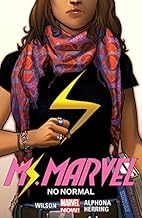
36. Ms. Marvel Vol 1: No Normal by G. Willow Wilson and Adrian Alphona
Maybe I'm finally getting the hang of reading graphic novels, because this one completely blew me away. It's about a 16-year-old Pakistani-American girl in Jersey City who's suddenly bestowed with shape-shifting superpowers--and then has to figure out how to control them and make use of them even while grounded. And the characters and setting are SO vivid.
Showing posts with label War of 1812. Show all posts
Monday, March 23, 2015
Thursday, July 3, 2014
2014 reading, books 67-69
67) The Internal Enemy: Slavery and War in Virginia, 1772-1832 by Alan Taylor
The 2014 Pulitzer Prize winner for History focuses on a little-known side of one of America's lesser-known wars, the War of 1812, and how Virginian slaves escaped to British ships during Britain's naval raids in the Chesapeake. An illuminating look at the American South a few decades after the Revolution and before the Civil War, not to mention British and American concepts of freedom.
68) The Serpent Garden by Judith Merkle Riley
I adore Riley's Margaret of Ashbury trilogy--in fact, it's one of my comfort re-reads--but I'd never read any of her other books before. This book, set early in the reign of Henry VIII, was enjoyable but not as good as the Margaret books. I felt like it focused too much on the plot and the various villains dabbling in demonology and court intrigue and not enough on the protagonist, who as a result didn't seem as alive and compelling as Margaret. (Incidentally, I'd class it as more historical fantasy than historical fiction, since the supernatural is even more unambiguous and prominent than in the Margaret books.)
69) Dare to Kiss by Jo Beverley
A short novella set in Beverley's Georgian Malloren world about a widow and her five children taken in on a freezing winter night by a reclusive bachelor. She has a scandalous past, and his reclusiveness springs from a physical deformity, and I liked that both the scandal and the deformity are REAL, and not a case of her being falsely accused nor him having scars he thinks are disfiguring but that many women would find sexy.
The 2014 Pulitzer Prize winner for History focuses on a little-known side of one of America's lesser-known wars, the War of 1812, and how Virginian slaves escaped to British ships during Britain's naval raids in the Chesapeake. An illuminating look at the American South a few decades after the Revolution and before the Civil War, not to mention British and American concepts of freedom.
68) The Serpent Garden by Judith Merkle Riley
I adore Riley's Margaret of Ashbury trilogy--in fact, it's one of my comfort re-reads--but I'd never read any of her other books before. This book, set early in the reign of Henry VIII, was enjoyable but not as good as the Margaret books. I felt like it focused too much on the plot and the various villains dabbling in demonology and court intrigue and not enough on the protagonist, who as a result didn't seem as alive and compelling as Margaret. (Incidentally, I'd class it as more historical fantasy than historical fiction, since the supernatural is even more unambiguous and prominent than in the Margaret books.)
69) Dare to Kiss by Jo Beverley
A short novella set in Beverley's Georgian Malloren world about a widow and her five children taken in on a freezing winter night by a reclusive bachelor. She has a scandalous past, and his reclusiveness springs from a physical deformity, and I liked that both the scandal and the deformity are REAL, and not a case of her being falsely accused nor him having scars he thinks are disfiguring but that many women would find sexy.
Tuesday, December 13, 2011
Books read, week of 12/13
Even as I scramble my way through a hectic holiday season, I'm finding time to read. (I'm also waiting with eager anticipation to see what my LibraryThing Secret Santas got me and Miss Fraser. Neither of my Santees was much of a romance reader, but I'm hoping they'll like my fantasy choices. I got both of them some Bujold and one His Majesty's Dragon, which apparently was one of the top ten most-given books this year.)
In the meantime, I've been reading...
The Deception of the Emerald Ring, by Lauren Willig. I'm not always the biggest fan of spy Regencies, but I love this series because it never takes itself too seriously and yet is very intelligently written--not an easy combination to find.
Bold, Brave, and Born to Lead: Major General Isaac Brock and the Canadas, by Mary Beacock Fryer. As I'm sure the title reveals, I got this book as research for An Infamous Marriage. It's YA military history/biography. Not sure how wide a readership that gets, but it's just right for what I'm looking for--information to give my hero, a protege of Brock's, a backstory without getting bogged down in minutiae. (Brock, for those of you who've never heard of him--a group that would've included me until a few months ago!--was probably the most talented British commander in the War of 1812 and is regarded as a hero in Canada for blocking American attempts to invade in the summer and fall of 1812. Unfortunately for the British and their Native American allies, he died less than a year into the war.)
Raised Right, by Alisa Harris, is a memoir by a young woman raised in the Religious Right who's kept her faith but changed her politics...and that's really all I can say about it without saying more about religion and politics than I like to do on this blog. Suffice it to say that if it sounds relevant to you, you'd probably enjoy reading it.
In the meantime, I've been reading...
The Deception of the Emerald Ring, by Lauren Willig. I'm not always the biggest fan of spy Regencies, but I love this series because it never takes itself too seriously and yet is very intelligently written--not an easy combination to find.
Bold, Brave, and Born to Lead: Major General Isaac Brock and the Canadas, by Mary Beacock Fryer. As I'm sure the title reveals, I got this book as research for An Infamous Marriage. It's YA military history/biography. Not sure how wide a readership that gets, but it's just right for what I'm looking for--information to give my hero, a protege of Brock's, a backstory without getting bogged down in minutiae. (Brock, for those of you who've never heard of him--a group that would've included me until a few months ago!--was probably the most talented British commander in the War of 1812 and is regarded as a hero in Canada for blocking American attempts to invade in the summer and fall of 1812. Unfortunately for the British and their Native American allies, he died less than a year into the war.)
Raised Right, by Alisa Harris, is a memoir by a young woman raised in the Religious Right who's kept her faith but changed her politics...and that's really all I can say about it without saying more about religion and politics than I like to do on this blog. Suffice it to say that if it sounds relevant to you, you'd probably enjoy reading it.
Sunday, November 20, 2011
Trading with the enemy
One of the more surprising things I've learned in my recent study of the War of 1812 was that, before the war, America was a major supplier of grain to Wellington's army in Portugal and Spain...and that this commerce continued DURING the war, with the approval of both governments. The British kept buying because their Peninsular army needed to eat, and a series of bad harvests in Europe around that time made America the most reliable supplier available. And the Americans kept selling because the government didn't want to turn its farmers against the war by depriving them of a valuable market for their crops. Also, just because they were at war with Britain didn't make them allied with France, and they were perfectly happy to help keep the bulk of Britain's army and its best commander in the field in Europe, fighting someone else. Makes sense, once you understand their reasoning.
However, in reading Adam Hochschild's book on World War I, To End All Wars, I discovered a far more baffling case of trading with the enemy. The British, you see, found themselves short of binoculars for their officers and NCOs, and lacking the capacity to manufacture them quickly, since it wasn't an industry they specialized in. At the same time, the British naval blockade cut the Germans off from their sources of rubber, also an important military commodity by that time. Germany, however, was well set up to make binoculars. So they set up a top-secret trade. Um...Whiskey? Tango? Foxtrot? Actively trading military technology with your direct enemy in a war brutal beyond example?
(Though I can't confirm the truth of the WWI story. Hochschild's research seems thorough to me, but googling turns up nothing but debates over whether it really happened. I hope it didn't, because WWI really doesn't need another level of senselessness. Sure, the War of 1812 was as pointless a conflict as was ever fought, but at least it was relatively small-scale, and the combatant nations have been at peace ever since. As for World War I...well, the British had more casualties on the first day of the Battle of the Somme than they had regular soldiers in the War of 1812. And we all know how well the Treaty of Versailles worked out...)
However, in reading Adam Hochschild's book on World War I, To End All Wars, I discovered a far more baffling case of trading with the enemy. The British, you see, found themselves short of binoculars for their officers and NCOs, and lacking the capacity to manufacture them quickly, since it wasn't an industry they specialized in. At the same time, the British naval blockade cut the Germans off from their sources of rubber, also an important military commodity by that time. Germany, however, was well set up to make binoculars. So they set up a top-secret trade. Um...Whiskey? Tango? Foxtrot? Actively trading military technology with your direct enemy in a war brutal beyond example?
(Though I can't confirm the truth of the WWI story. Hochschild's research seems thorough to me, but googling turns up nothing but debates over whether it really happened. I hope it didn't, because WWI really doesn't need another level of senselessness. Sure, the War of 1812 was as pointless a conflict as was ever fought, but at least it was relatively small-scale, and the combatant nations have been at peace ever since. As for World War I...well, the British had more casualties on the first day of the Battle of the Somme than they had regular soldiers in the War of 1812. And we all know how well the Treaty of Versailles worked out...)
Labels:
Peninsular War,
research,
War of 1812,
World War I
Sunday, November 13, 2011
More on the War of 1812
Still researching the War of 1812, and still looking back at James Madison et al. and asking them, "What the HELL were you thinking picking that fight? Do you have any IDEA how lucky you were to get away with a draw?"
Though, to give my countrymen of 200 years ago credit, a lot of that is my 20-20 hindsight talking. They went into it with the not-at-all-illogical assumption that Napoleon was going to continue as master of Europe, and that he'd either gradually wear the British down or that the European wars would keep going and going and going. Fighting to get some trade and territorial concessions out of an apparently weakened and certainly distracted Britain made all kinds of sense. It's easy to see now that Napoleon was already past his peak as a commander, and that the cracks were starting to show in his empire. While it was actually happening, from the other side of the Atlantic? Probably not so much.
American declared war on 18 June 1812. Three years to the day before Waterloo. And less than a week before Napoleon crossed the Niemen River into Russia--and if there's a single event that sealed his doom, it's that invasion. It's kinda hard to come back from a campaign where you lose over 80% of the army you went in with.
So, yeah, my fellow Americans guessed wrong on that one. Oops.
Though, to give my countrymen of 200 years ago credit, a lot of that is my 20-20 hindsight talking. They went into it with the not-at-all-illogical assumption that Napoleon was going to continue as master of Europe, and that he'd either gradually wear the British down or that the European wars would keep going and going and going. Fighting to get some trade and territorial concessions out of an apparently weakened and certainly distracted Britain made all kinds of sense. It's easy to see now that Napoleon was already past his peak as a commander, and that the cracks were starting to show in his empire. While it was actually happening, from the other side of the Atlantic? Probably not so much.
American declared war on 18 June 1812. Three years to the day before Waterloo. And less than a week before Napoleon crossed the Niemen River into Russia--and if there's a single event that sealed his doom, it's that invasion. It's kinda hard to come back from a campaign where you lose over 80% of the army you went in with.
So, yeah, my fellow Americans guessed wrong on that one. Oops.
Tuesday, November 8, 2011
Books read, week of 11/8
I finished two books in the last week, both of them on the depressing/tragic side.
Tecumseh: A Life, by John Sugden, is a biography of the Shawnee leader who tried to create a confederation of Native Americans from the Great Lakes to the Gulf, and who died in the War of 1812 fighting in alliance with the British. I read it as research for the WIP, and found it slow going because Sugden was so determined to stick to facts over speculation that much of the first 2/3 of the book was necessarily vague. The War of 1812 section, being better documented, was more compelling.
History is full of what-ifs for me, but what makes Tecumseh's story such a tragedy is that I can't find any way for it to have ended differently. The man was brilliant--charismatic, politically savvy, far-seeing, courageous. He was probably the equal in ability to just about any man of his generation (and he was born in the late 1760's, like Napoleon, Wellington, and Andrew Jackson, to name just three of his most famous peers). But there was just no way it could've been enough. The odds were far too stacked against his confederacy. They didn't have the numbers, the divisions between and within tribes were too strong, America was insatiably land-hungry, and Tecumseh's cause was never going to be that high of a priority for his British allies. There is no What Might Have Been. But I still admire what he was and what he tried to bring into being.
An Unquiet Mind, by Kay Redfield Jamison, is a memoir of the author's life as a professor of psychiatry who has bipolar disorder. I read it as part of my grieving process for a friend...and it was as harrowing and difficult as I expected it to be, though I'm glad I got through it.
Tecumseh: A Life, by John Sugden, is a biography of the Shawnee leader who tried to create a confederation of Native Americans from the Great Lakes to the Gulf, and who died in the War of 1812 fighting in alliance with the British. I read it as research for the WIP, and found it slow going because Sugden was so determined to stick to facts over speculation that much of the first 2/3 of the book was necessarily vague. The War of 1812 section, being better documented, was more compelling.
History is full of what-ifs for me, but what makes Tecumseh's story such a tragedy is that I can't find any way for it to have ended differently. The man was brilliant--charismatic, politically savvy, far-seeing, courageous. He was probably the equal in ability to just about any man of his generation (and he was born in the late 1760's, like Napoleon, Wellington, and Andrew Jackson, to name just three of his most famous peers). But there was just no way it could've been enough. The odds were far too stacked against his confederacy. They didn't have the numbers, the divisions between and within tribes were too strong, America was insatiably land-hungry, and Tecumseh's cause was never going to be that high of a priority for his British allies. There is no What Might Have Been. But I still admire what he was and what he tried to bring into being.
An Unquiet Mind, by Kay Redfield Jamison, is a memoir of the author's life as a professor of psychiatry who has bipolar disorder. I read it as part of my grieving process for a friend...and it was as harrowing and difficult as I expected it to be, though I'm glad I got through it.
Tuesday, October 4, 2011
Weekly book post
Now that I'm settling in to my new day job, I've decided to shoot for three blog posts per week, on Sundays, Tuesdays, and Thursdays. The Sunday post will be whatever is on my mind, usually writing or research-related, or a guest post. Thursdays will be food and cooking, as I try to work my way through at least one new recipe from every cookbook I own. And Tuesdays will be my reading updates.
So, here's what I've read since the last time I blogged my reading. It's a bit heavy on the nonfiction and research books, partly because I'm working out my hero's backstory of service in and around Upper Canada during the War of 1812 and partly because my library holds list suddenly spat out a pile of nonfiction all at once.
1) The War of 1812: A Forgotten Conflict, by Donald Hickey
A fairly in-depth history. It focuses on the American point-of-view but was still useful for giving me an overview of how the war played out. At the risk of letting my contemporary political views show a bit, the War of 1812 comes across as depressingly reminiscent of the Iraq War in some ways--the party in power pulled the country into it for rather dubious reasons and damned anyone who disagreed as traitors, for example.
2) Crown and Calumet: British-Indian Relations, 1783-1815, by Colin Calloway
As the title says, a book all about relations between the British and Native Americans from the end of the American Revolution through the War of 1812. Fascinating, at least for me, because it's an aspect of Native American history I'd never run across before.
3) Love Story, by Jennifer Echols
A YA romance where the hero and heroine work out their feelings for each other and complex history together over the course of a writing seminar as college freshmen. I enjoyed it, as I always do Echols' books, though I have to admit I would've liked to see a longer last chapter or an epilogue or something just to sort of enjoy the couple together after all they went through to get there.
4) This Republic of Suffering: Death and the American Civil War, by Drew Gilpin Faust
I was lucky enough to take Drew Faust's class on the American South 1607-1861 lo these many years ago as a Penn undergrad, so when I saw this book mentioned on a blog (more than likely Ta-Nehisi Coates' place), I sought it out. It's a depressing read--naturally, since it's a book about death--but I couldn't put it down all the same. It's about how the massive carnage of the Civil War changed how Americans related to war deaths in particular and mortality in general. One of the many things that struck me was that in the 19th century, a dead soldier's family wouldn't have found any consolation in hearing that their son/husband/brother died so suddenly that he didn't have time to suffer. Instead, they valued the "Good Death," wherein the dying person knows what's happening, accepts it with a show of faith and resignation (so consoling to the family as reassurance they'll see him again in heaven), and passes on loving messages and words of wisdom for those left behind. So when soldiers did die instantly, their friends would write their families these reassuring messages about how Joe saw this coming, he had a premonition and was perfectly resigned to the possibility and had been living a good and prayerful life, and so on.
So, here's what I've read since the last time I blogged my reading. It's a bit heavy on the nonfiction and research books, partly because I'm working out my hero's backstory of service in and around Upper Canada during the War of 1812 and partly because my library holds list suddenly spat out a pile of nonfiction all at once.
1) The War of 1812: A Forgotten Conflict, by Donald Hickey
A fairly in-depth history. It focuses on the American point-of-view but was still useful for giving me an overview of how the war played out. At the risk of letting my contemporary political views show a bit, the War of 1812 comes across as depressingly reminiscent of the Iraq War in some ways--the party in power pulled the country into it for rather dubious reasons and damned anyone who disagreed as traitors, for example.
2) Crown and Calumet: British-Indian Relations, 1783-1815, by Colin Calloway
As the title says, a book all about relations between the British and Native Americans from the end of the American Revolution through the War of 1812. Fascinating, at least for me, because it's an aspect of Native American history I'd never run across before.
3) Love Story, by Jennifer Echols
A YA romance where the hero and heroine work out their feelings for each other and complex history together over the course of a writing seminar as college freshmen. I enjoyed it, as I always do Echols' books, though I have to admit I would've liked to see a longer last chapter or an epilogue or something just to sort of enjoy the couple together after all they went through to get there.
4) This Republic of Suffering: Death and the American Civil War, by Drew Gilpin Faust
I was lucky enough to take Drew Faust's class on the American South 1607-1861 lo these many years ago as a Penn undergrad, so when I saw this book mentioned on a blog (more than likely Ta-Nehisi Coates' place), I sought it out. It's a depressing read--naturally, since it's a book about death--but I couldn't put it down all the same. It's about how the massive carnage of the Civil War changed how Americans related to war deaths in particular and mortality in general. One of the many things that struck me was that in the 19th century, a dead soldier's family wouldn't have found any consolation in hearing that their son/husband/brother died so suddenly that he didn't have time to suffer. Instead, they valued the "Good Death," wherein the dying person knows what's happening, accepts it with a show of faith and resignation (so consoling to the family as reassurance they'll see him again in heaven), and passes on loving messages and words of wisdom for those left behind. So when soldiers did die instantly, their friends would write their families these reassuring messages about how Joe saw this coming, he had a premonition and was perfectly resigned to the possibility and had been living a good and prayerful life, and so on.
Labels:
Civil War,
reading,
research,
War of 1812,
YA
Sunday, September 25, 2011
A mind full of new things
I survived my first week at my new job. It's going pretty well so far, but the nature of the work is such that I'll have little weekday daytime internet access. So I won't be spending as much time in the Twitterverse and blogosphere as I've been used to doing.
I'm also in deep research mode for my 2012 novel. For reasons that would take too long to go into here, my editor asked me to change my hero's background from service in India and then in the Peninsular War to the War of 1812. Which is fine, except for the tiny obstacle that until the last ten days or so ago I knew next to nothing about the conflict in question. Seriously, if you'd asked me what I knew about it, I would've said something along the lines of, "I think it was mostly about impressment of American citizens into the British navy. Oh, and Francis Scott Key wrote 'The Star-Spangled Banner' while watching the bombardment of Fort McHenry, the British burned the White House, and Andrew Jackson won the Battle of New Orleans, which was fought after the peace treaty was signed, only of course no one could've known because there hadn't been enough time for the news to cross the Atlantic." In other words, not nearly enough to give my hero a proper backstory.
Why, you may ask, do I know so much about the Napoleonic Wars and next to nothing about a war my own country actually fought in? Well, my dirty little secret is I started researching the military side of the era because I had a crush on this guy:

And the more I researched, the more I became an admirer of this genteman:

...neither of whom were at all involved in the War of 1812. Though the government did ask Wellington if he'd go in late 1814. He said, basically, that he had no objections to going, but he'd like to wait till spring in hopes of finishing business at the Congress of Vienna, and, besides, unless the British could reestablish naval superiority in the Great Lakes, another general and more soldiers wouldn't help all that much. There's probably a counterfactual or two to be had there--what if Wellington had been in command of the British forces at New Orleans? No WAY would he have attacked such a well-chosen and well-defended position. Half of Wellington's considerable battlefield genius was choosing his ground well, whether on offense or defense, and only giving battle when his forces were in a position to prevail. If Andrew Jackson never got the prestige he garnered at New Orleans, it's doubtful he would've been elected president, and American history would be much different. And if Wellington hadn't been at Waterloo, I still don't think Napoleon would've gotten to keep his throne--Europe was too united against him--but he probably would've lasted longer, and the different manner of his defeat would've reshaped European history.
So, yeah. You can probably already tell that, ten days of researching in, I've become fascinated by the War of 1812 in spite of myself. It really ought to be taught more thoroughly in schools--that bit I'd learned about American sailors getting impressed into the Royal Navy is a GROSS oversimplification of the causes of the war. It's really appalling how the then-ruling Democratic-Republican Party maneuvered the US into the war despite being ill-prepared for it, suppressed dissent, and somehow came out even MORE powerful and claiming victory despite the fact we were lucky to escape with a draw. I'm still no admirer of Andrew Jackson.

Mr. Fraser and therefore Miss Fraser are members of the Cherokee Nation, so Jackson was no friend of my family's ancestors. Of course, I'm definitely a Scots-Irish Southerner and almost certainly part Creek myself...so history is complicated. But when I think Jackson, I think Indian Removal and the Trail of Tears first.
I was quickly reminded that Tecumseh was also involved in the War of 1812, though, and I think my hero is going to meet him. Because Tecumseh was AWESOME.
I'm such a research geek. But it's so FUN.
I'm also in deep research mode for my 2012 novel. For reasons that would take too long to go into here, my editor asked me to change my hero's background from service in India and then in the Peninsular War to the War of 1812. Which is fine, except for the tiny obstacle that until the last ten days or so ago I knew next to nothing about the conflict in question. Seriously, if you'd asked me what I knew about it, I would've said something along the lines of, "I think it was mostly about impressment of American citizens into the British navy. Oh, and Francis Scott Key wrote 'The Star-Spangled Banner' while watching the bombardment of Fort McHenry, the British burned the White House, and Andrew Jackson won the Battle of New Orleans, which was fought after the peace treaty was signed, only of course no one could've known because there hadn't been enough time for the news to cross the Atlantic." In other words, not nearly enough to give my hero a proper backstory.
Why, you may ask, do I know so much about the Napoleonic Wars and next to nothing about a war my own country actually fought in? Well, my dirty little secret is I started researching the military side of the era because I had a crush on this guy:

And the more I researched, the more I became an admirer of this genteman:

...neither of whom were at all involved in the War of 1812. Though the government did ask Wellington if he'd go in late 1814. He said, basically, that he had no objections to going, but he'd like to wait till spring in hopes of finishing business at the Congress of Vienna, and, besides, unless the British could reestablish naval superiority in the Great Lakes, another general and more soldiers wouldn't help all that much. There's probably a counterfactual or two to be had there--what if Wellington had been in command of the British forces at New Orleans? No WAY would he have attacked such a well-chosen and well-defended position. Half of Wellington's considerable battlefield genius was choosing his ground well, whether on offense or defense, and only giving battle when his forces were in a position to prevail. If Andrew Jackson never got the prestige he garnered at New Orleans, it's doubtful he would've been elected president, and American history would be much different. And if Wellington hadn't been at Waterloo, I still don't think Napoleon would've gotten to keep his throne--Europe was too united against him--but he probably would've lasted longer, and the different manner of his defeat would've reshaped European history.
So, yeah. You can probably already tell that, ten days of researching in, I've become fascinated by the War of 1812 in spite of myself. It really ought to be taught more thoroughly in schools--that bit I'd learned about American sailors getting impressed into the Royal Navy is a GROSS oversimplification of the causes of the war. It's really appalling how the then-ruling Democratic-Republican Party maneuvered the US into the war despite being ill-prepared for it, suppressed dissent, and somehow came out even MORE powerful and claiming victory despite the fact we were lucky to escape with a draw. I'm still no admirer of Andrew Jackson.

Mr. Fraser and therefore Miss Fraser are members of the Cherokee Nation, so Jackson was no friend of my family's ancestors. Of course, I'm definitely a Scots-Irish Southerner and almost certainly part Creek myself...so history is complicated. But when I think Jackson, I think Indian Removal and the Trail of Tears first.
I was quickly reminded that Tecumseh was also involved in the War of 1812, though, and I think my hero is going to meet him. Because Tecumseh was AWESOME.
I'm such a research geek. But it's so FUN.
Labels:
research,
War of 1812,
Waterloo book,
writing
Subscribe to:
Posts (Atom)
